6 Ways UAE’s Real Estate Market Adapts to Hybrid Work Trends
May 28, 2025


The UAE, long known for its architectural marvels and ambitious development vision, is undergoing a new transformation — one shaped not by steel and glass alone, but by how people work. With hybrid work models becoming the norm, real estate developers, investors, and city planners are facing a critical need to rethink how buildings and communities are designed, marketed, and utilized.
This evolution — broadly referred to as Hybrid Work Adaptation — is driving radical changes in both commercial and residential real estate as well as the principles of investments in commercial vs residential real estate in Dubai and the UAE. From flexible leases and smart infrastructure to decentralized work hubs and wellness-focused living, the UAE is proactively embracing the future of work.
The Ministry of Human Resources and Emiratisation (MoHRE) has advised private sector companies to apply flexible and remote work patterns tomorrow, 2 May 2024, to maintain the health and safety of their workers in light of the expected weather conditions. This comes after…
— وزارة الموارد البشرية والتوطين (@MOHRE_UAE) May 1, 2024
In this article, we’ll explore six key ways the real estate market is adapting, followed by insights into current challenges, future trends, and notable case studies that illustrate the hybrid transformation in action.
The UAE was one of the first countries in the region to introduce remote work visa programs, enabling foreign nationals to live in the Emirates while working for global employers. This policy has led to a significant influx of digital nomads and remote professionals, increasing demand for hybrid-friendly properties.
According to a 2023 McKinsey survey, 90% of employers embrace a range of hybrid work models, citing productivity and mental health benefits. This shift has forced employers — and the real estate sector — to respond with greater spatial flexibility and wellness integration.
Dubai’s Smart City initiative, 5G coverage, and nationwide fiber optic networks have laid the foundation for high-speed remote working environments. This infrastructure makes Hybrid Work Adaptation feasible even outside central business districts.

Developers are shifting from traditional office leases to flexible office models, including:
Companies like Cloud Spaces, The Executive Centre, and WeWork have seen rising demand across Dubai and Abu Dhabi. According to The National, Grade A office occupancy in Dubai reached 97% in 2023, driven largely by hybrid office needs.
Source: The National News
Tenants now prioritize floor plans with:
Many residential developments now allocate square footage for “Zoom rooms” or wellness pods. This adaptation has made hybrid-capable residences highly competitive in the leasing market.
According to Kaizen Asset Management Services, over 43% of hybrid workers in Dubai consider home-office suitability as a top leasing factor.
Areas like Dubai South, Jumeirah Lake Towers (JLT), and Abu Dhabi’s Reem Island are becoming preferred locations for hybrid firms seeking mid-tier rents and lower congestion. Developers are integrating office clusters, retail zones, and residential units — forming 15-minute communities.
Smart buildings are gaining traction, offering:
These features not only improve efficiency but also meet ESG criteria. As sustainability gains prominence, Hybrid Work Adaptation is becoming an opportunity to push green architecture forward.
Landlords now offer:
This marks a sharp shift from the 3-to-5-year lease norms of pre-2020. Tenants gain flexibility, while landlords maintain occupancy through diversified portfolios, building strong relationships between landlord and tenants in Dubai and UAE.
Hybrid workers demand more than connectivity — they want quality of life. Mixed-use projects now incorporate:
This blending of personal and professional life is a cornerstone of Hybrid Work Adaptation in the UAE’s urban vision.
Many city zoning codes are still geared toward rigid residential or commercial use, limiting mixed-use transformation speed.
Older buildings lack infrastructure for fiber internet, energy optimization, or modular layouts — making adaptation cost-intensive.
Smart work environments raise concerns around data privacy, particularly in co-working or shared spaces using AI and surveillance tech.
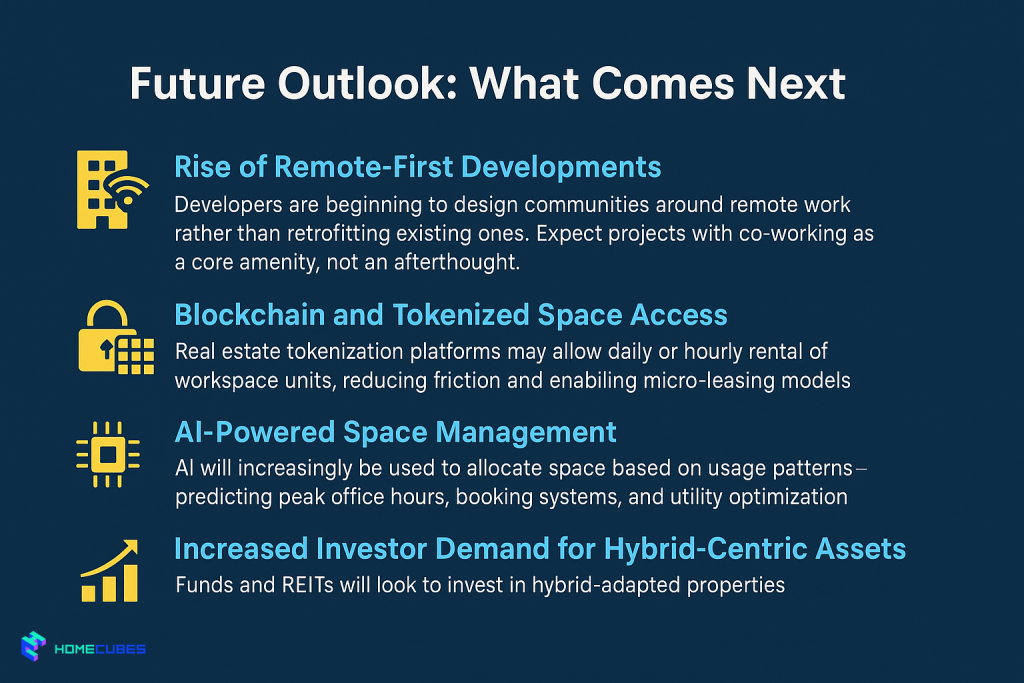
Developers are beginning to design communities around remote work rather than retrofitting existing ones. Expect projects with co-working as a core amenity, not an afterthought.
Real estate tokenization platforms may allow daily or hourly rental of workspace units, reducing friction and enabling micro-leasing models.
AI will increasingly be used to allocate space based on usage patterns — predicting peak office hours, booking systems, and utility optimization.
Funds and REITs will look to invest in hybrid-adapted properties with:
Dubai CommerCity, the region’s first e-commerce free zone, includes flexible offices, shared logistics, and business lounges tailored to hybrid professionals.
Aldar’s partnership with Cloud Spaces in Abu Dhabi’s Yas Mall and Reem Mall transformed underused retail space into high-end co-working hubs — exemplifying hybrid adaptive reuse.
The rise of hybrid work has fundamentally altered how the UAE approaches real estate — in design, leasing, regulation, and community development. Hybrid Work Adaptation is no longer a short-term solution; it is a blueprint for resilient, sustainable, and future-ready urban growth.
From Dubai’s evolving skyline to Abu Dhabi’s innovative communities, this transformation is creating new investment channels and lifestyle standards. Real estate stakeholders who embrace this shift now will be those who lead tomorrow.
At Homecubes, we’re closely tracking these paradigm shifts in the UAE’s real estate market. While we are currently awaiting our VARA license and not yet operational, we are building future-ready solutions that align with hybrid real estate demand — including fractional ownership, tokenized leasing, and digital investment pathways.
Want to stay ahead of hybrid real estate trends?
👉 Contact Homecubes to join our early interest list and get priority access once our platform goes live.
Table of Contents Introduction Global Demand Dubai Real Estate – Snapshot Why Dubai Stands Out…
Dubai’s real estate market has moved from a speculative frontier to a globally recognized hub…
Table of Contents Introduction Market Overview: H1 2025 by the Numbers Key Drivers Behind the…