Post-Handover Payment Plans UAE: A Smarter Way to Buy Property in 2025
February 25, 2025


Dubai’s real-estate market continues to evolve — not only in skyline design but in how buyers and investors structure their purchases. One of the most impactful trends shaping the 2025 property landscape is the rise of Post-Handover Payment Plans UAE, giving buyers the power to own first and pay later.
Unlike traditional off-plan models that require buyers to settle the full cost before handover, these flexible plans allow you to receive the keys to your property, rent it, or live in it while continuing to pay the balance over time.
This approach aligns perfectly with the UAE’s economic vision for inclusivity, innovation, and global investor accessibility. According to CBRE UAE Real Estate Market Review Q2 2025, over one-third of new off-plan sales in Dubai now include extended post-handover payment schedules.
Dubai real estate breaks records. In just 290 days of 2025, property sales have hit Dh525.87 billion, already surpassing the total sales of all 2024. A historic milestone underscoring Dubai’s booming property market and investor confidence.$UAE $GCC $GMCC $XGCC $NBD $FAB pic.twitter.com/fHEi4VivFj
— Arthur Benta (@ArthurBenta) October 24, 2025
The appeal is simple: a buyer can own a property sooner, spread payments more comfortably, and even generate rental income while paying down the balance. For expatriates, entrepreneurs, and investors seeking flexibility, Post-Handover Payment Plans in the UAE are redefining what it means to invest smartly in Dubai real estate.
A post-handover payment plan is a financing model where the developer allows buyers to pay a portion of the property’s price after handover. Instead of front-loading all payments during construction, a segment — usually 30–50 % — is deferred over a fixed term after completion.
This structure is common in Dubai, Abu Dhabi, and increasingly in Sharjah for both residential and mixed-use developments. For buyers, it provides a financial bridge between ownership aspiration and liquidity constraints, while developers enjoy faster absorption rates and broader buyer reach.
A standard plan looks like this:
Payments post-handover are typically interest-free and made directly to the developer. Buyers receive ownership rights and can occupy or lease the property immediately after handover, as long as payments remain on schedule.
This model particularly benefits investors seeking income-generating assets, since rental proceeds can offset remaining installments. Developers such as Emaar, Sobha, Damac, and Azizi have all implemented these flexible structures in 2025 launches to attract both local and overseas buyers.
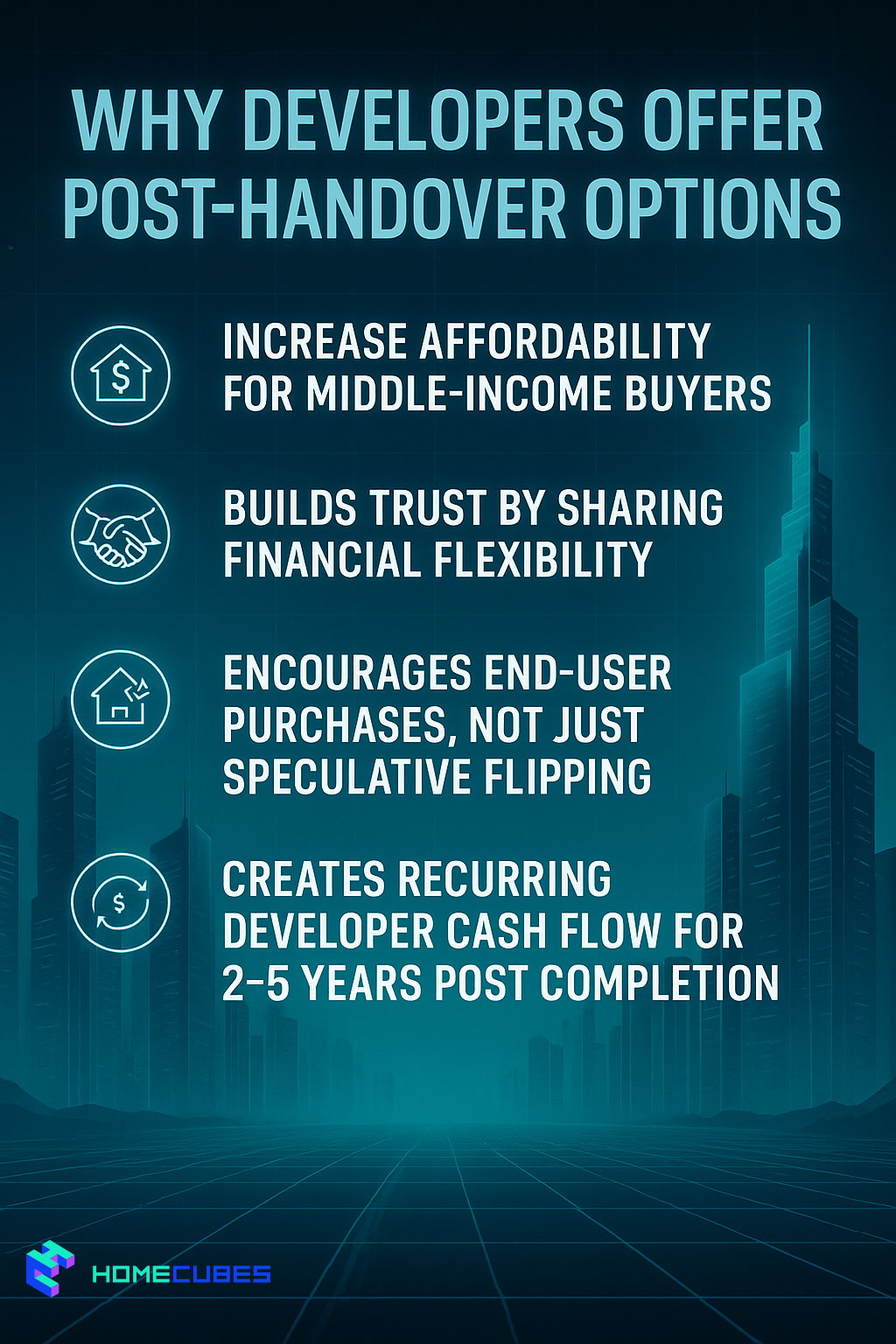
The UAE’s developers use post-handover plans to strengthen sales velocity, attract new investor demographics, and maintain project liquidity.
According to ValuStrat’s H1 2025 Report, off-plan projects offering post-handover schedules have achieved up to 40 % higher transaction volumes than projects requiring full pre-handover payment.
Why it works for developers:
In short, post-handover payment plans in the UAE have become a win-win instrument for both developers and investors — balancing accessibility with long-term confidence.
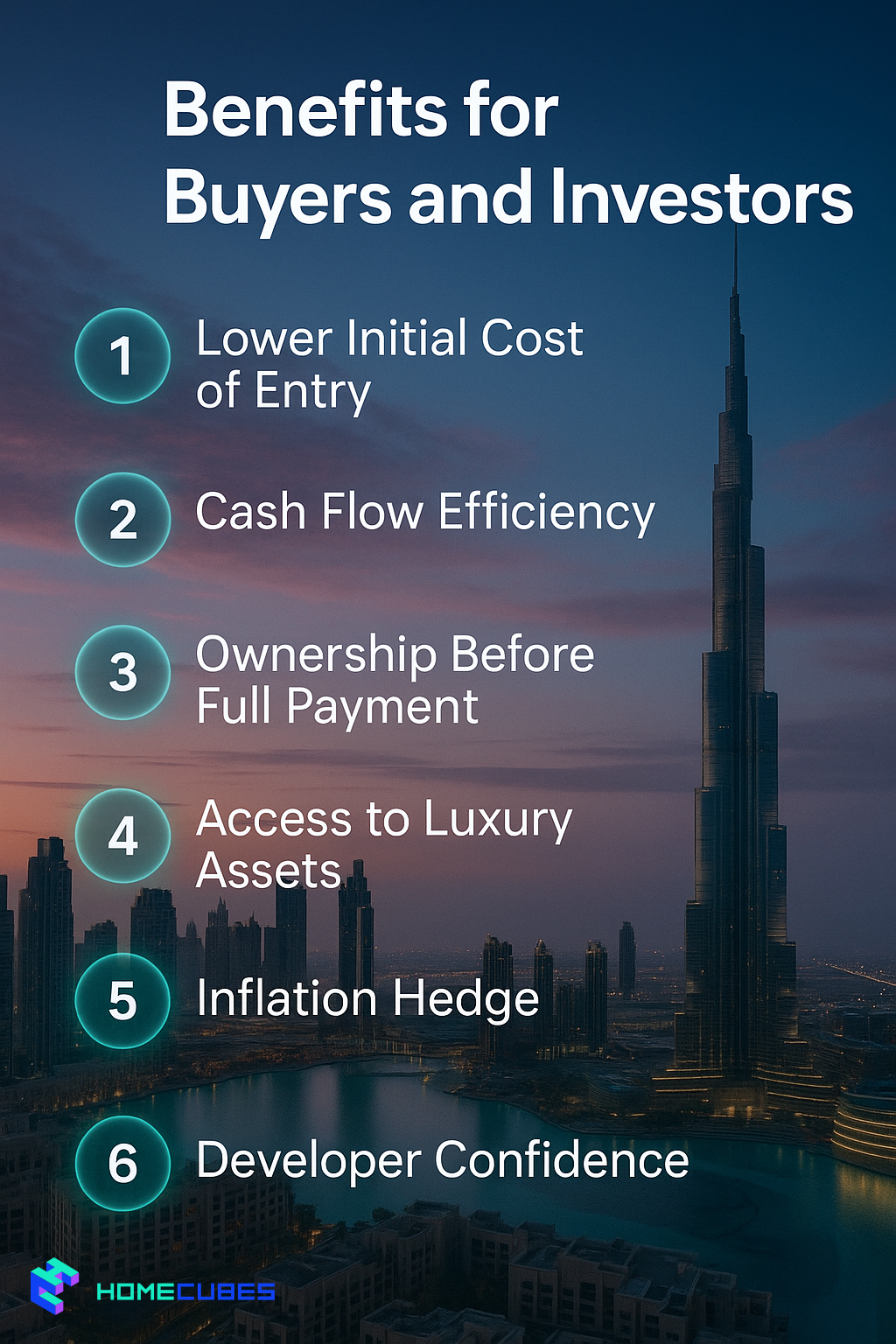
Buyers can secure ownership with limited upfront capital — often just 10–15 % at booking — making premium developments attainable without large cash commitments.
Payments align with income growth or rental returns. This model lets you keep liquidity for other investments or emergencies while acquiring real assets.
You take possession upon handover and can rent, occupy, or resell under contract conditions — enabling asset utility while still completing payments.
Post-handover terms open access to communities like Dubai Hills, Emaar Beachfront, or Sobha Hartland that might otherwise require full pre-handover financing.
Other than global inflation impact on UAE real estate, paying over multiple years allows investors to benefit from inflation. Future installments are effectively made in dirhams that may hold less real value, while property prices and rents rise.
Developers who offer post-handover flexibility usually have strong reputations and funding capacity — another signal of reliability.
While the advantages are significant, it’s important to balance expectations.
Project: Sobha One, Ras Al Khor, Dubai
Property Type: 2-bedroom apartment
Price: AED 2.4 million
Payment Plan: 10 % at booking, 50 % during construction, 40 % over 4 years post-handover
Investor Strategy Example:
An investor pays AED 1.44 million before completion and takes possession upon handover. The property rents for AED 130,000 annually, covering more than one-third of the post-handover installments.
If the market continues its 6 % yearly appreciation (as seen in Cavendish Maxwell’s Dubai Residential Market Performance H1 2025), the apartment’s value could rise to AED 3 million by 2029 — turning flexible payments into long-term capital gains.
This case illustrates why Post-Handover Payment Plans UAE have become a preferred strategy among yield-focused investors: they blend income with appreciation while keeping capital commitments staggered.
| Fee Type | Average Cost | Details |
| DLD Registration Fee | 4 % | Payable on SPA registration |
| Oqood Fee | AED 1,000 | Required for off-plan registration |
| Service Charges | AED 15–30 / sq. ft. yearly | Building & community maintenance |
| Agency Commission | 2 % | Broker’s fee |
| Property Management Fee | 5–8 % of rent | Optional if leasing |
| Late Payment Penalties | Developer-specific | Apply only for overdue installments |
1️⃣ Skipping Developer Due Diligence – Only invest in RERA-approved and track-record-verified projects.
2️⃣ Assuming Guaranteed Rent – Always confirm area rental demand using reputable sources like Betterhomes, Bayt, etc.
3️⃣ Ignoring Legal Fine Print – Ensure flexibility for resale or early settlement is clearly defined.
4️⃣ Underestimating Maintenance Costs – Even in new projects, upkeep costs start immediately after handover.
5️⃣ Lack of Exit Strategy – Define whether you plan to hold, lease, or sell — and align your payment schedule accordingly.
The 2025–2030 outlook for Post-Handover Payment Plans UAE remains extremely positive. With demand diversifying across income segments and global investor bases, developers are expected to make these structures a permanent part of their sales strategy.
According to Global Property Guide 2025, UAE residential prices are projected to rise 4–7 % annually through 2030, supported by population growth, tourism recovery, and fintech integration.
Betterhomes’ Q2 2025 Report also highlights that 80 % of developers surveyed plan to retain or expand post-handover options in upcoming projects.
As Dubai’s smart-city initiatives and digital tokenization frameworks mature, post-handover plans could soon merge with blockchain-based fractional ownership — allowing investors to buy smaller shares and automate payments securely through regulated digital ledgers.
They’re flexible developer financing schemes that let buyers own property in Dubai or Abu Dhabi and complete payments over several years after handover — ideal for expats and investors seeking manageable installment structures.
Buyers pay a smaller portion during construction, receive the keys upon completion, and pay the remaining 30–50 % post-handover, usually without interest.
Most are interest-free as long as payments stay on schedule, but developers often include a small price premium (around 3–5 %) for the flexibility.
Yes. Non-residents can purchase properties in designated freehold zones under post-handover terms — including Dubai Marina, Business Bay, and Palm Jumeirah.
Pros: lower upfront cost, ownership before full payment, and potential rental income.
Cons: possible price premium, strict payment timelines, and limited resale flexibility.
It depends on your liquidity and risk profile. Post-handover plans offer flexibility and speed, while mortgages offer lower long-term costs and refinancing potential.
Yes. Many investors lease properties post-handover and use the rental income to cover installment payments.
Developers may charge penalties or revoke ownership rights after repeated missed payments. Always maintain a contingency fund to cover gaps.
The Post-Handover Payment Plans UAE model has become a defining feature of Dubai’s 2025 property cycle — bridging affordability, flexibility, and investor confidence. It enables ownership without immediate full payment, creating opportunities for both first-time buyers and experienced investors to access high-quality real estate.
However, success depends on informed planning: choose reputable developers, read the fine print, and align your investment horizon with your financial capabilities.
In a fast-evolving landscape moving toward blockchain-based tokenization and digital payments, post-handover plans are set to play an even greater role in making property ownership smarter, more inclusive, and globally accessible.
Homecubes is developing a blockchain-driven fractional real-estate investment platform that allows users to purchase tokenized shares in premium Dubai properties — combining liquidity, compliance, and transparency.
Aligned with VARA and the Dubai Land Department’s Real Estate Tokenization eService, Homecubes represents the next step toward accessible, regulated digital property ownership.
Note: Homecubes has applied for its VARA license and will launch services once approved.
For early registration or partnership inquiries, visit https://homecubes.io/contact-us/.

Table of Contents Introduction Global Demand Dubai Real Estate – Snapshot Why Dubai Stands Out…

Dubai’s real estate market has moved from a speculative frontier to a globally recognized hub…
Table of Contents Introduction Market Overview: H1 2025 by the Numbers Key Drivers Behind the…