

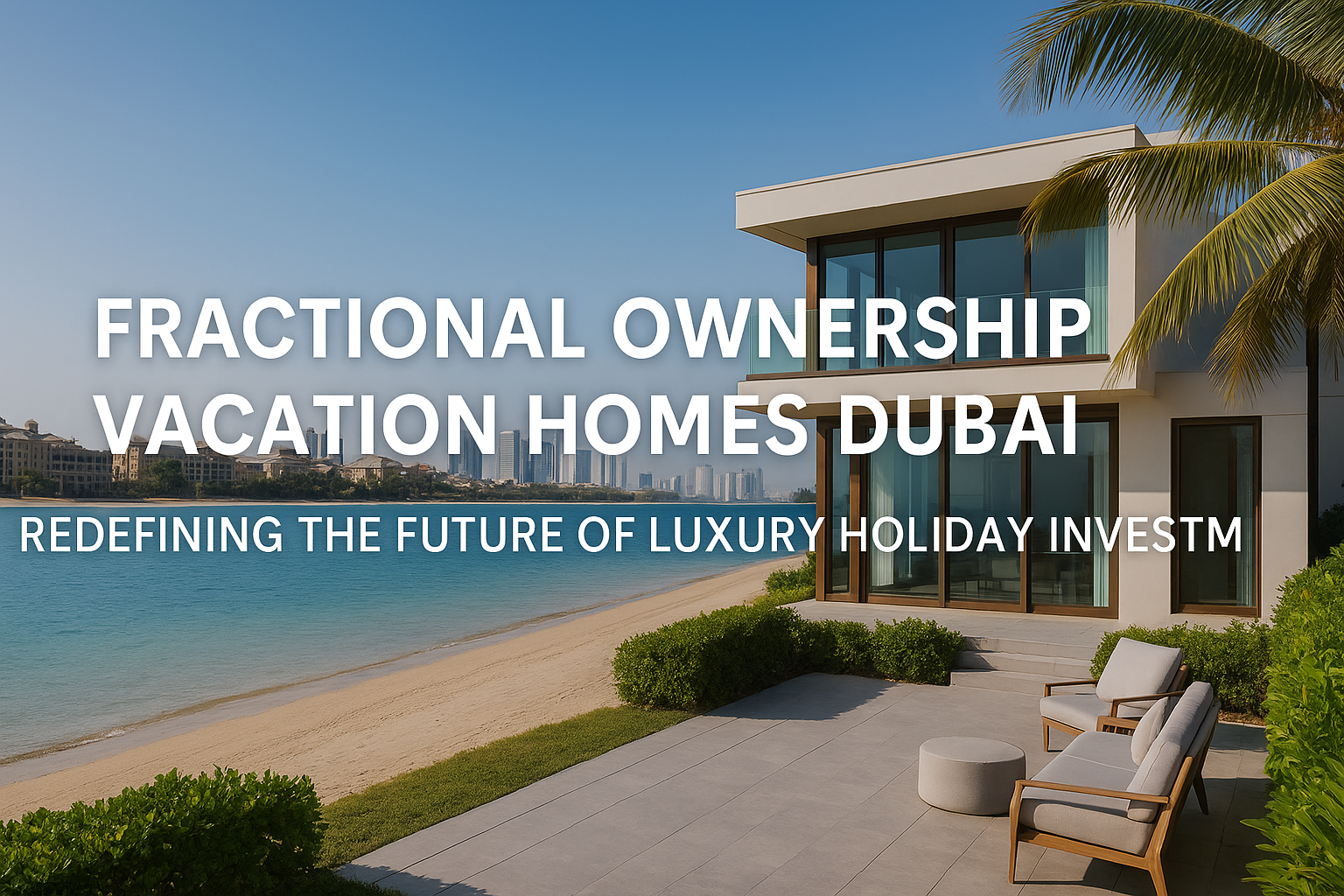
Fractional Ownership Vacation Homes Dubai: Redefining the Future of Luxury Holiday Investment
November 22, 2024


Table of Contents
Dubai has long stood as the world’s luxury tourism capital, blending iconic architecture, pristine beaches, and cutting-edge infrastructure. In 2024 alone, the city welcomed over 18.7 million international visitors, according to the Dubai Department of Economy and Tourism’s December 2024 Report.
This influx has created robust demand for short-term vacation rentals and second homes. Yet, skyrocketing property prices—especially across Palm Jumeirah, Dubai Marina, and Downtown—have placed full ownership beyond the reach of many investors.
Enter fractional ownership vacation homes Dubai, a model that allows investors to co-own luxury holiday properties while sharing income, appreciation, and costs. This approach is reshaping how investors experience and profit from Dubai’s real-estate landscape.
Fractional ownership of luxury real estate is now within reach.
MultiBank Group, in partnership with MAG Lifestyle Development, is making it possible for everyone to own a piece of premium property.
From the Ritz-Carlton Residences in Dubai to prime assets worldwide, luxury… pic.twitter.com/oCPrMge5SD
— MultiBank.io (@multibank_io) August 29, 2025
Fractional ownership divides property equity into smaller, legally recognized shares. Each investor owns a percentage—often between 1% and 25%—and receives proportional rights to:
Unlike timeshares, fractional ownership conveys real property interest, commonly registered through a Special Purpose Vehicle (SPV) or via Dubai Land Department’s (DLD) Tokenization eService.
This structure delivers flexibility, legal clarity, and transparency while minimizing financial exposure.
Dubai’s appeal lies in its blend of world-class tourism, investor-friendly regulation, and digital-asset readiness.
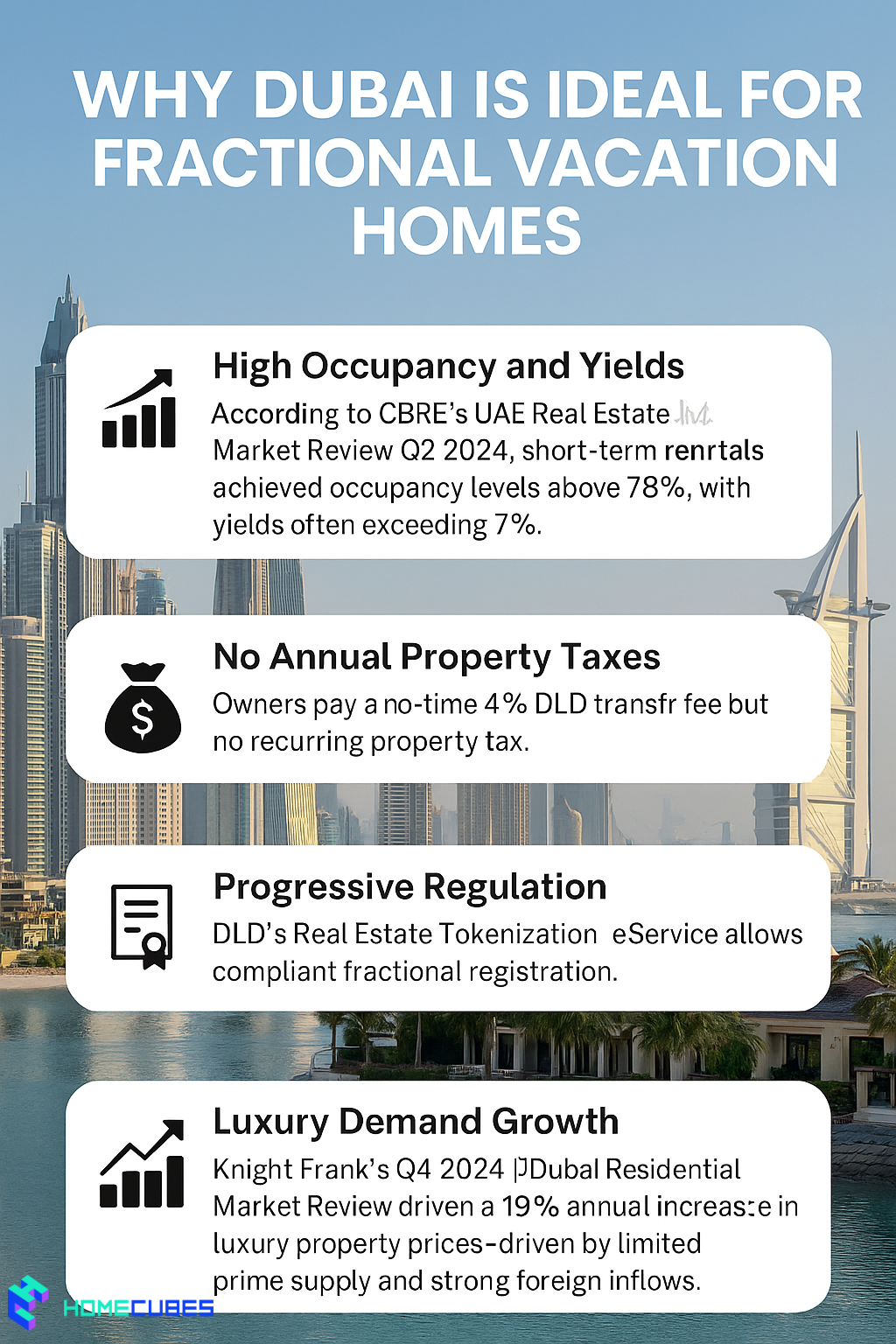
These conditions make fractional ownership a practical on-ramp to Dubai’s luxury property market.
Dubai’s vacation-home market remains one of the most resilient globally. CBRE data shows a surge in tourism-linked occupancy, while Knight Frank highlights luxury demand growth across Palm Jumeirah, Jumeirah Bay Island, and Dubai Hills.
Key trends include:
Dubai’s combination of digital infrastructure and investor trust continues to anchor its position as the world’s most forward-thinking vacation home market.
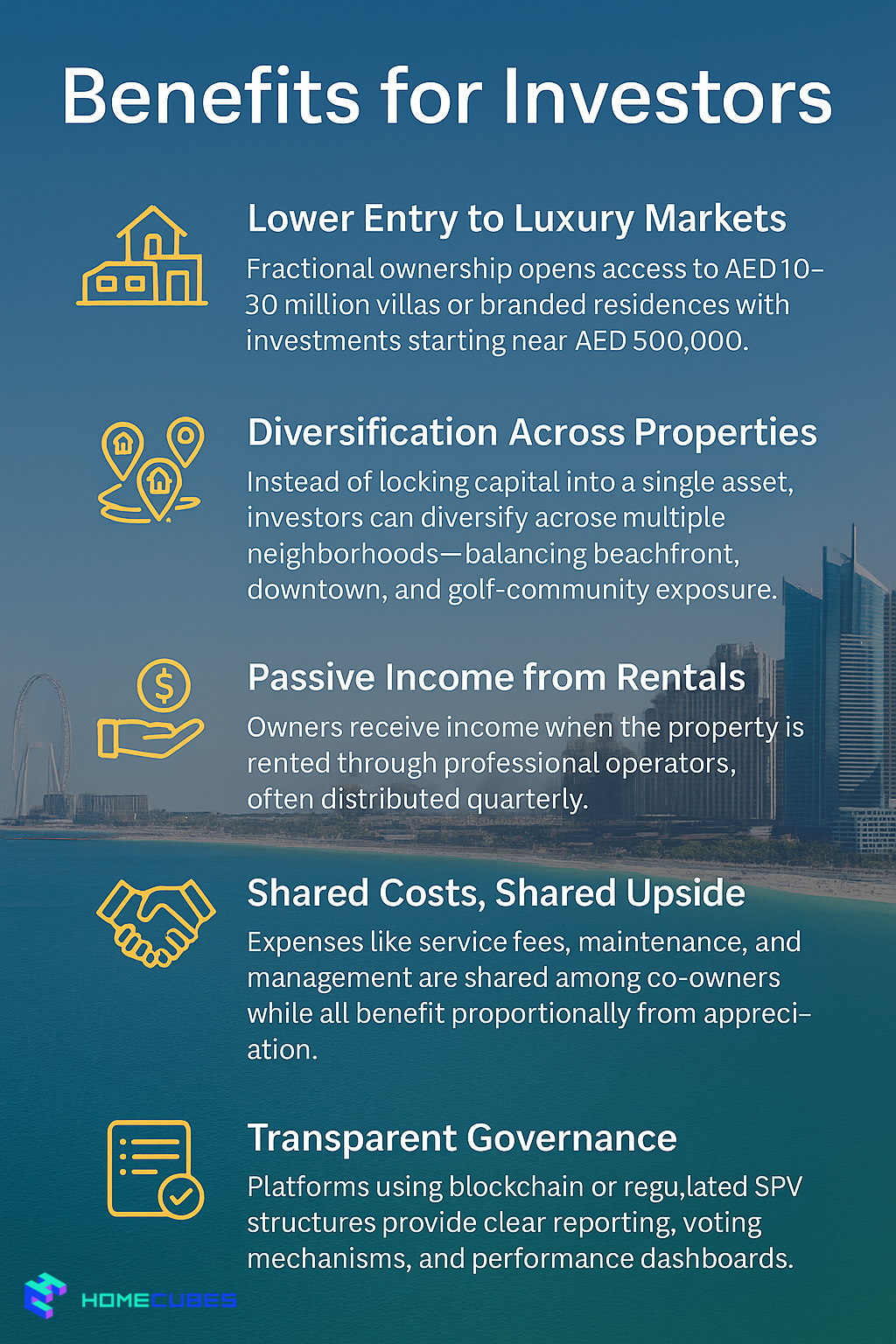
Fractional ownership opens access to AED 10–30 million villas or branded residences with investments starting near AED 500,000.
Instead of locking capital into a single asset, investors can diversify across multiple neighborhoods—balancing beachfront, downtown, and golf-community exposure.
Owners receive income when the property is rented through professional operators, often distributed quarterly.
Expenses like service fees, maintenance, and management are shared among co-owners while all benefit proportionally from appreciation.
Platforms using blockchain or regulated SPV structures provide clear reporting, voting mechanisms, and performance dashboards.
Dubai’s regulatory system is internationally recognized for its clarity and investor protections.
These frameworks collectively protect fractional investors while allowing innovation through tokenized property structures.
A luxury beachfront villa on Palm Jumeirah valued at AED 24 million was divided into 12 equal shares priced at AED 2 million each.
Structure:
Results (2024–2025):
This model demonstrates how fractional structures reduce risk, enhance liquidity, and broaden access to Dubai’s most prestigious real estate.
Selecting licensed operators, verifying compliance, and understanding liquidity options mitigate these risks.
| Fee Type | Typical Range | Description |
| DLD Transfer Fee | 4% of asset value | One-time title registration |
| Platform Setup | 1–3% of share value | Legal, SPV, onboarding costs |
| Management Fee | 15–25% of rental revenue | Covers booking, cleaning, maintenance |
| Service Charges | Variable (by RERA) | Building/community upkeep |
| Exit Fee | ~1% | Secondary resale or buy-back facilitation |
Always evaluate net yield after all fees, not headline returns.
Avoiding these pitfalls ensures your investment aligns with Dubai’s compliance-driven ecosystem.
Fractional ownership and real-estate tokenization will define Dubai’s next decade of property innovation.
Forecasts by Knight Frank and CBRE point toward:
Dubai’s ability to merge regulation, innovation, and investor trust positions it to lead the global tokenized real-estate era.
Is fractional ownership in Dubai vacation homes legal under DLD and VARA?
Yes. The DLD recognizes fractional ownership through SPVs, and VARA governs tokenized or digital-asset-based real-estate models to ensure compliance.
How profitable are fractional vacation home investments in Dubai?
Yields typically range from 6–9% annually, depending on property type, operator, and seasonality, with additional capital appreciation potential.
Can foreign investors buy fractional vacation homes in Dubai?
Absolutely. Foreigners can co-own vacation homes in designated freehold areas such as Palm Jumeirah, Business Bay, and Downtown Dubai.
What legal documents do investors need for fractional ownership in Dubai?
Key documents include the SPV shareholders’ agreement, co-ownership contract, property-management agreement, and AML/KYC verification.
How can investors exit or resell their fractional ownership shares in Dubai?
Liquidity options depend on the platform—some offer internal resale boards or tokenized secondary markets, while others permit private transfers after a holding period.
The rise of fractional ownership vacation homes Dubai marks a defining shift in global property investing. It merges the lifestyle of luxury ownership with financial accessibility, diversification, and transparency.
By leveraging compliant structures, investors can enjoy premium stays, recurring rental income, and potential appreciation—all under Dubai’s progressive regulatory umbrella.
For serious investors, fractional models represent the bridge between traditional real estate and blockchain-enabled liquidity.
Homecubes is advancing this transformation by building a compliant, transparent ecosystem aligned with Dubai Land Department’s Tokenization eService and Virtual Assets Regulatory Authority (VARA) frameworks.
⚠️ Homecubes has applied for its VARA license, and services will officially launch upon approval.
Until then, we continue developing tokenization infrastructure, investor-education programs, and compliance-ready tools for Dubai’s next era of property investment.
👉 Explore upcoming opportunities at https://homecubes.io/contact-us/.
Table of Contents Introduction Global Demand Dubai Real Estate – Snapshot Why Dubai Stands Out…
Dubai’s real estate market has moved from a speculative frontier to a globally recognized hub…
Table of Contents Introduction Market Overview: H1 2025 by the Numbers Key Drivers Behind the…


