How Artificial Intelligence is Shaping Dubai’s Real Estate Market
February 6, 2025


Dubai’s real estate market has long been synonymous with ambition and innovation. From luxury skyscrapers to mega-communities, the city continues to push boundaries. Today, artificial intelligence (AI) is taking center stage in this transformation. AI in real estate Dubai is no longer an experimental tool — it is a powerful driver of efficiency, growth, and competitiveness.
The emirate’s government has already placed AI at the heart of its smart city strategy. For property developers, brokers, and investors, adopting AI means keeping pace with Dubai’s scale, complexity, and global demand. This article explores how AI is being applied in Dubai’s property market, the opportunities and challenges it presents, the financial implications, and how Homecubes is preparing to integrate AI into its future services.
Today, I reviewed a Dubai Center for Artificial Intelligence study which reveals that over 800 AI companies are thriving in Dubai. They have chosen Dubai as their base due to the city’s advanced infrastructure, progressive regulations, and innovative services, all driven by the… pic.twitter.com/W0p2hpRvGc
— Hamdan bin Mohammed (@HamdanMohammed) December 12, 2024
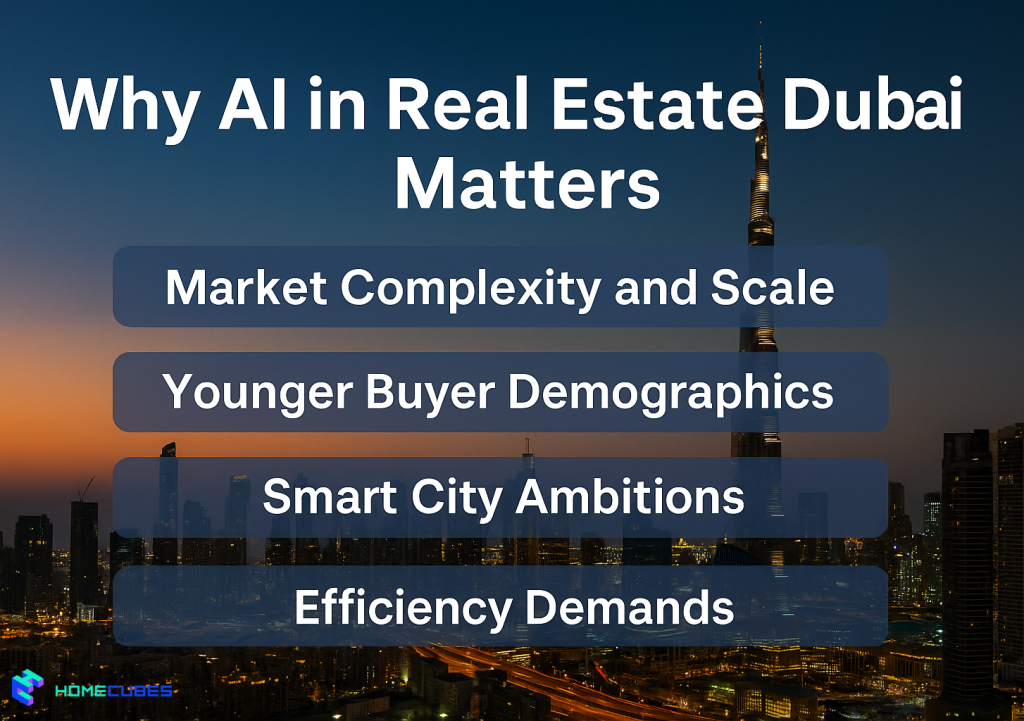
Dubai recorded nearly 181,000 real estate transactions worth AED 522 billion in 2024, a record year that highlights the scale of activity (Knight Frank Q1 2025 Review). With so much data moving so quickly, AI becomes an essential tool for analysis, valuation, and forecasting.
The average age of buyers in Dubai has fallen sharply in recent years. This younger, tech-savvy demographic demands digital-first solutions — from virtual tours to instant valuations. AI provides the personalization and speed these buyers expect.
Dubai’s Smart City 2031 Vision prioritizes AI integration across multiple industries. Real estate sits at the intersection of this transformation, as smart buildings, smart eco-villages in the UAE, predictive valuations, and AI-powered compliance become standard.
Margins in real estate are under pressure. AI enables cost savings through predictive maintenance, automated lead qualification, and marketing optimization. According to PwC, AI could contribute up to USD 320 billion to the Middle East’s economy by 2030 — real estate will capture a significant share.
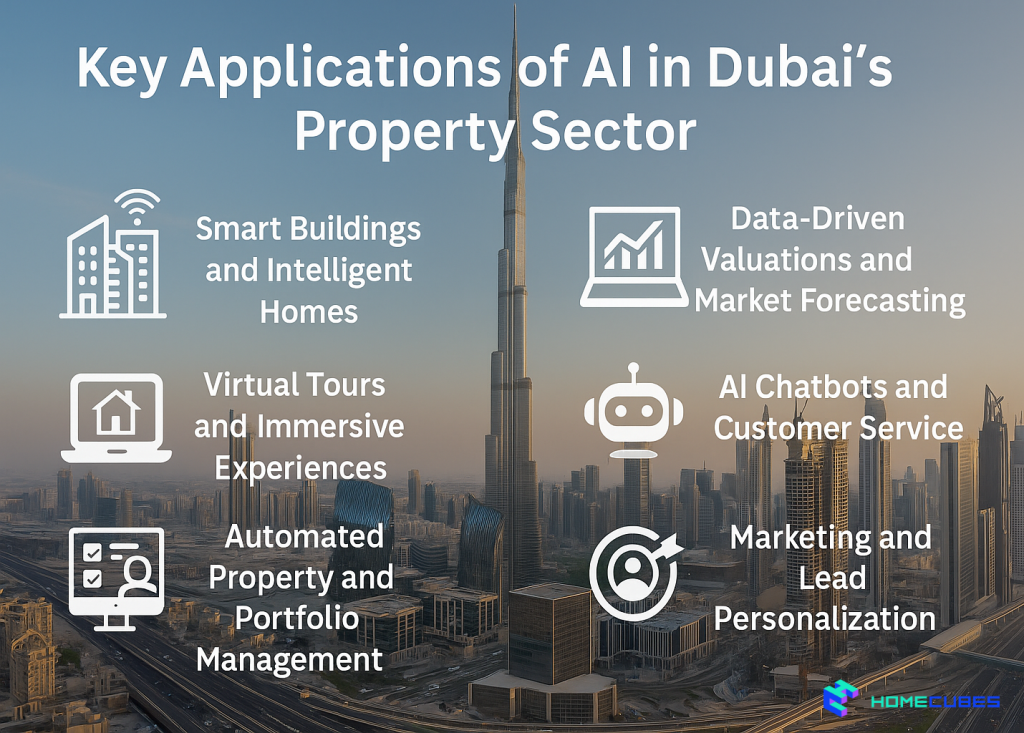
Dubai’s climate and luxury property market make AI-powered smart systems highly valuable. From predictive HVAC adjustments to AI-based energy optimization, buildings are becoming more sustainable and cost-effective. Security is also enhanced through AI-enabled facial recognition and anomaly detection.
Traditional property valuation relies heavily on manual expertise. AI changes this by processing massive datasets — from transaction history to infrastructure planning. Models provide faster, more accurate valuations and forecast demand shifts across districts. For example, Knight Frank noted that Dubai residential prices surged 19% in 2024 as demand shifted towards prime neighborhoods (Zawya Report). AI models can capture such trends early, supporting smarter investment decisions.
With a global investor base, many buyers in Dubai rely on remote tools to evaluate properties. AI enhances AR/VR tours by tailoring walkthroughs to user interests, highlighting specific features, and even suggesting design options in real time.
AI-powered chatbots deliver 24/7 responses to inquiries, qualify leads, and schedule viewings. They also integrate with CRM systems, reducing administrative workloads and ensuring no lead is left unattended.
AI streamlines rent tracking, maintenance scheduling, and vacancy prediction. Property managers in Dubai’s competitive rental market use AI to optimize occupancy and improve tenant satisfaction.
AI allows hyper-targeted ad campaigns, predictive lead scoring, and personalized content delivery. For developers, this translates into lower marketing spend and higher conversion rates particularly in Dubai’s top suburb experiencing a real estate boom in 2025.
With Dubai’s growing regulatory frameworks, AI tools assist in scanning contracts for risks, ensuring compliance with Dubai Land Department (DLD) and RERA standards, and generating lease templates automatically.
A UAE pilot project in 2025 tested an AI valuation tool that reduced property valuation times by 80% and improved accuracy by over 20%. By leveraging transaction records and economic signals, the system delivered near real-time pricing to agents and investors.
In another Dubai-based example, a developer adopted an AI-driven digital platform for property discovery and contract management. This shift led to a 19% increase in sales efficiency, as the platform analyzed client preferences and automated routine processes.
Both cases show that AI is already providing measurable improvements in Dubai’s property ecosystem.
Pilot projects typically cost USD 200,000–500,000. Scaling across portfolios may double or triple this figure. Ongoing costs are generally 15–25% annually to cover model retraining and system upkeep.
Most Dubai-based AI real estate projects achieve ROI in 18–36 months, depending on adoption rates and operational scope.
Dubai is poised to lead globally in AI-powered real estate. Several trends stand out:
Dubai’s pro-innovation environment ensures these trends will materialize faster than in most global hubs.
AI is not replacing Dubai’s real estate professionals — it is empowering them. By automating routine work, delivering deeper insights, and enhancing customer experiences, AI makes the sector more transparent, efficient, and globally competitive. The firms that adapt now will shape Dubai’s property future over the next decade.
What is AI in real estate Dubai?
It is the use of artificial intelligence to optimize valuations, marketing, property management, compliance, and investment decisions in Dubai’s property sector.
How accurate are AI property valuations?
Studies in the UAE show AI tools can improve valuation accuracy by 20%+ and cut processing time by 80%, though human oversight is still recommended.
Are there regulations around AI in Dubai real estate?
Yes. Tools must comply with DLD, RERA, and UAE data protection frameworks.
How much does AI adoption cost?
Pilot projects run USD 200k–500k, with larger implementations costing more. ROI is usually seen within 2–3 years.
Can AI replace agents?
Not entirely. AI assists with efficiency and data, but human expertise and negotiation remain essential.
What trends will shape AI in Dubai’s property market?
IoT convergence, blockchain integration, autonomous AI agents, and explainable AI regulations.
How can smaller firms adopt AI affordably?
By using SaaS AI tools for chatbots, analytics, and lead scoring instead of building in-house solutions.
The transformation of Dubai’s property sector through AI is well underway. From valuations and immersive experiences to predictive analytics and compliance tools, AI is defining how investors and residents interact with the market.
At Homecubes, we are preparing to integrate AI into our upcoming real estate tokenization platform. With our pending VARA license, we are committed to delivering secure, compliant, and innovative solutions once approval is finalized. Our goal is to empower investors and property owners with AI-driven insights, transparent valuations, and streamlined management.
👉 Connect with Homecubes to register your interest and be among the first to access our AI-powered services once launched.

Table of Contents Introduction Global Demand Dubai Real Estate – Snapshot Why Dubai Stands Out…

Dubai’s real estate market has moved from a speculative frontier to a globally recognized hub…
Table of Contents Introduction Market Overview: H1 2025 by the Numbers Key Drivers Behind the…