Legal Aspects of Buying Property in the UAE with Cryptocurrency: 2025 Guide
January 16, 2025


Dubai’s property market has always pushed boundaries—from off-plan sales to blockchain title pilots. The next frontier is buying property with cryptocurrency.
As Web3 investment grows, global buyers are exploring whether digital assets can fund freehold purchases. In the UAE, this question is no longer hypothetical. Licensed intermediaries now facilitate crypto-to-AED conversions that comply with Dubai Land Department (DLD) rules and the Virtual Assets Regulatory Authority (VARA) framework.
🇦🇪 JUST IN: UAE’s real estate giant RAK Properties will start accepting payments in crypto including Bitcoin, Ethereum, and Tether’s USDT for international property transactions. pic.twitter.com/EXGl9AOuVD
— Cointelegraph (@Cointelegraph) September 2, 2025
Understanding the legal aspects of buying property cryptocurrency UAE is essential: the process is valid and feasible, but governed by clear rules on AML, escrow, and registration.
Until a few years ago, paying for property in Bitcoin was treated as an unregulated novelty. That changed with the creation of VARA and subsequent legal reforms.
These initiatives collectively make Dubai one of the first jurisdictions to treat crypto-funded property sales as legitimate—provided conversions and registrations follow VARA and DLD protocols.
Five key agencies regulate every stage of a crypto-settled property transaction:
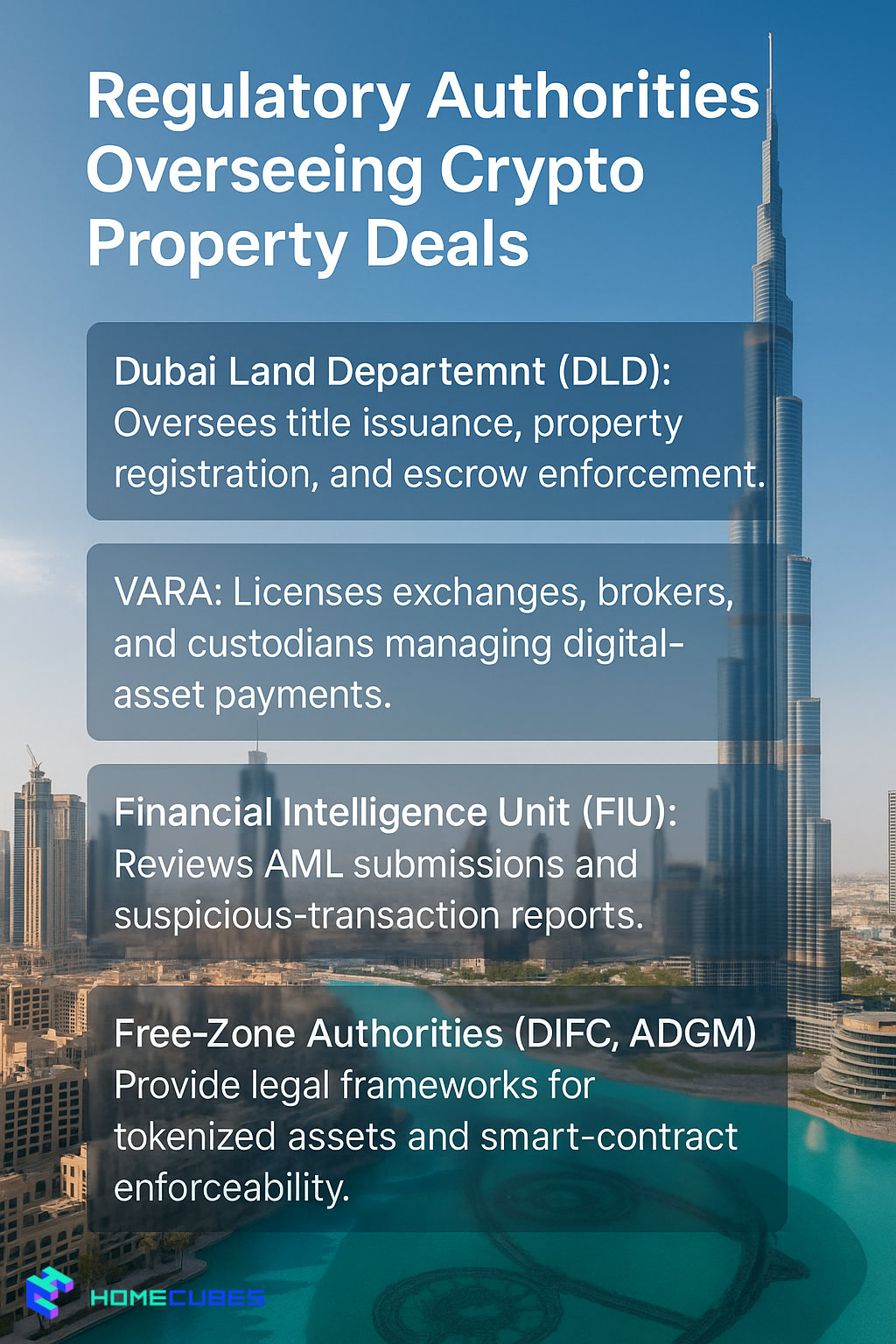
Each authority ensures crypto-based payments meet both property law and financial-compliance standards.
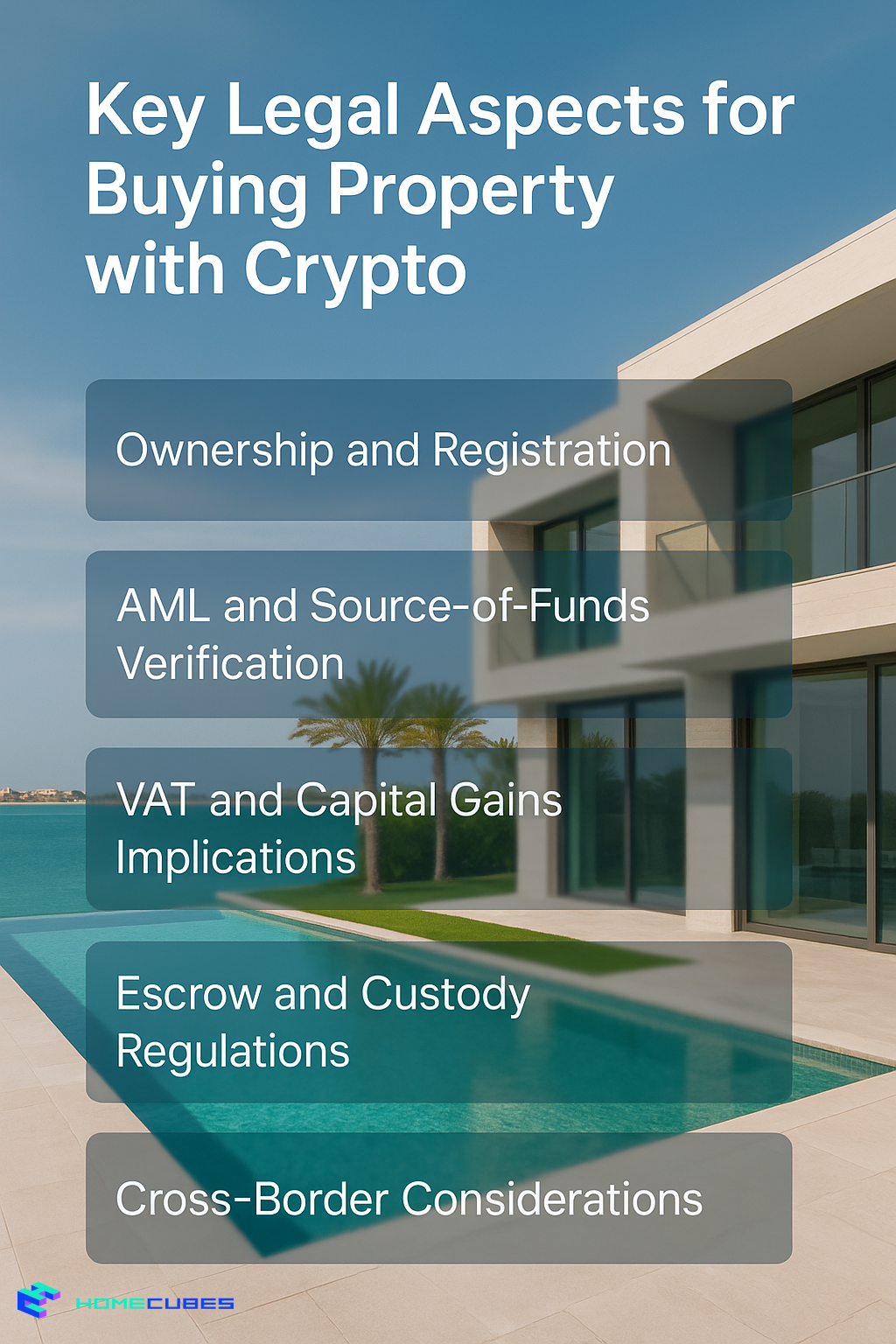
All property ownership remains anchored in the DLD’s registry. Regardless of payment method, the title deed is issued in the buyer’s legal name.
Crypto payments are only accepted when converted to AED through a VARA-licensed exchange, after which settlement occurs via a RERA-approved escrow account.
The conversion and registration sequence guarantees traceability under UAE civil and financial law.
Compliance with Federal Decree-Law No. 20 of 2018 and Cabinet Decision No. 10 of 2019 is mandatory.
Buyers must provide:
Global expectations mirror the FATF’s 2024 Targeted Update on Virtual Assets & VASPs, which sets international AML and Travel-Rule standards for crypto transactions.
Failure to evidence clean funds can delay or void registration.
Invoices must be denominated in AED for DLD audit compatibility.
Developer and broker payments must flow through RERA-approved escrow accounts in compliance with Dubai Law No. 8 of 2007 (Escrow Accounts for Real Estate Development).
To activate or manage escrow, developers use the DLD eService portal.
Crypto funds are first converted into AED, deposited in escrow, and then released upon DLD approval. Direct wallet-to-wallet transfers outside these channels remain non-compliant.
Foreign investors must:
These steps prevent double-jurisdiction risk and align with international compliance norms.
Scenario: In 2024, a European investor purchased a Dubai Marina apartment using Bitcoin.
Process:
Outcome:
Lesson: When executed through licensed channels, crypto-based purchases satisfy every legal requirement outlined by VARA and DLD.
Proactive compliance mitigates all these risks.
| Fee Type | Purpose | Typical Range |
| DLD Transfer Fee | Property registration | 4 % of property value |
| Title Deed Fee | Issuance & admin | AED 580 – 2 000 |
| Brokerage Fee | Agent commission | 2 % of value |
| Exchange Fee | VARA-licensed conversion | 0.5 – 1.5 % |
| Legal Fee | Contract & compliance | AED 5 000 – 15 000 |
Average all-in cost: about 6 – 8 % of property value—similar to fiat deals but often faster to clear.
Dubai’s next blockchain phase is real-estate tokenization—fractionalizing ownership into legally recognized tokens.
These steps position Dubai as a global hub for compliant tokenized real-estate markets.
Is it legal to buy property in Dubai with cryptocurrency in 2025?
Yes. Buying property with crypto in Dubai is legal when executed through VARA-licensed exchanges and RERA-approved escrow accounts that convert crypto to AED before registration.
What are the UAE regulations for buying real estate with cryptocurrency?
All transactions fall under VARA’s rulebooks, DLD’s escrow laws, and FATF-aligned AML standards. These ensure transparency and source-of-funds verification for every crypto-funded purchase.
Do I need a UAE residence visa to purchase real estate using cryptocurrency?
No. Foreign investors can legally buy freehold property in Dubai with crypto after completing KYC and wallet verification through approved intermediaries.
Are there taxes or hidden fees when buying property with cryptocurrency in the UAE?
The UAE has no income or capital-gains tax on crypto or property ownership. Only standard DLD transfer, title, and exchange fees apply. However, international investors should confirm tax rules in their home country.
Which cryptocurrencies are accepted for buying property in Dubai?
Bitcoin (BTC), Ethereum (ETH), and regulated stablecoins like USDT and USDC are most widely accepted, provided they are converted through VARA-licensed exchanges into AED for DLD escrow.
How is ownership recorded after a crypto property purchase in the UAE?
Ownership is still registered traditionally under the Dubai Land Department’s centralized system. Blockchain pilots for tokenized title deeds are in progress but not yet standard practice.
What are the risks of buying UAE real estate with cryptocurrency?
The main risks involve using unlicensed exchanges, unverified wallets, or failing AML checks. Following VARA and DLD procedures ensures full legal protection and compliance.
The legal aspects of buying property cryptocurrency UAE have evolved from uncertain territory to a well-regulated financial process underpinned by clear government oversight.
By combining VARA’s digital-asset rulebooks, DLD’s escrow and registration laws, and FATF-aligned AML standards, the UAE has built a framework that balances innovation with compliance.
This balance gives international investors in UAE confidence that crypto transactions can coexist with traditional property law without undermining financial integrity.
The country’s regulatory maturity also signals what’s next—tokenized property markets, real-estate NFTs, and blockchain-integrated title transfers. Dubai is effectively setting a global benchmark for transparent, tech-driven ownership models.
For crypto investors seeking regulated exposure to hard assets, the UAE offers speed, clarity, and a world-class real-estate ecosystem — making it one of the most forward-thinking jurisdictions for digital-asset-backed investment.
At Homecubes, we’re shaping the next generation of compliant, tokenized real-estate platforms in the UAE.
⚠️ Regulatory Notice: Homecubes has applied for its VARA license to operate as a real-estate tokenization provider. Our services will launch once approval is granted.
In the meantime, we’re building blockchain infrastructure aligned with DLD, VARA, and ADGM rules to ensure every future property token is fully compliant and investor-ready.
👉 Contact Homecubes to learn how tokenized property investment will redefine Dubai’s real-estate market.

Table of Contents Introduction Global Demand Dubai Real Estate – Snapshot Why Dubai Stands Out…

Dubai’s real estate market has moved from a speculative frontier to a globally recognized hub…

Table of Contents Introduction Market Overview: H1 2025 by the Numbers Key Drivers Behind the…