Benefits of Polygon Matic: Why It’s the Backbone of Ethereum Scaling and Web3 Growth
May 25, 2023


Ethereum remains the world’s most used blockchain for decentralized finance (DeFi) and Web3 applications. However, its congestion and high gas fees have long limited scalability. Polygon (MATIC) emerged as a leading Layer-2 ecosystem built to enhance Ethereum’s speed and affordability while preserving decentralization and security.
By 2025, Polygon has evolved into an expansive multi-chain framework supporting thousands of decentralized applications (dApps), Web3 startups, and tokenization projects.
According to Messari’s State of Polygon Q1 2025 report, Polygon handled 8.4 million daily transactions and recorded 18.9 million monthly active users, marking an 11 percent quarter-over-quarter increase.
These adoption metrics underscore why the benefits of Polygon Matic have made it indispensable to Ethereum scaling — and why enterprises such as Homecubes, building fractional real-estate investment and tokenization platforms in Dubai, increasingly favor it for efficiency and compliance readiness.
Polygon (formerly Matic Network) is a Layer-2 scaling platform that extends Ethereum’s capabilities. It uses Proof-of-Stake (PoS) validation, the Plasma framework, and now zk-rollup and zkEVM technology to process transactions faster and cheaper.
The native MATIC token, transitioning to POL under the Polygon 2.0 upgrade, fuels transaction fees, staking, and governance. Validators stake tokens to secure the network, while users pay negligible gas for on-chain activity.
Polygon’s modular design allows multiple chains — PoS, zkEVM, and custom CDK-based networks — to connect seamlessly with Ethereum, giving developers flexible scaling choices under one secure umbrella.
The Polygon Idea
The core purpose of Polygon is to make blockchain fast, cheap, and easy for everyone. Ethereum was slow and expensive when it initially became popular. Think about mailing $10 and having to pay $50 in fees. That difficulty kept millions of people from being…
— Paxton (@Buy_SomeBTC) October 10, 2025
Polygon doesn’t replace the Ethereum network — it enhances it. While Ethereum ensures unmatched decentralization and security, Polygon offloads computation and storage, creating a faster, cheaper, and user-friendly environment.
Key complementarities include:
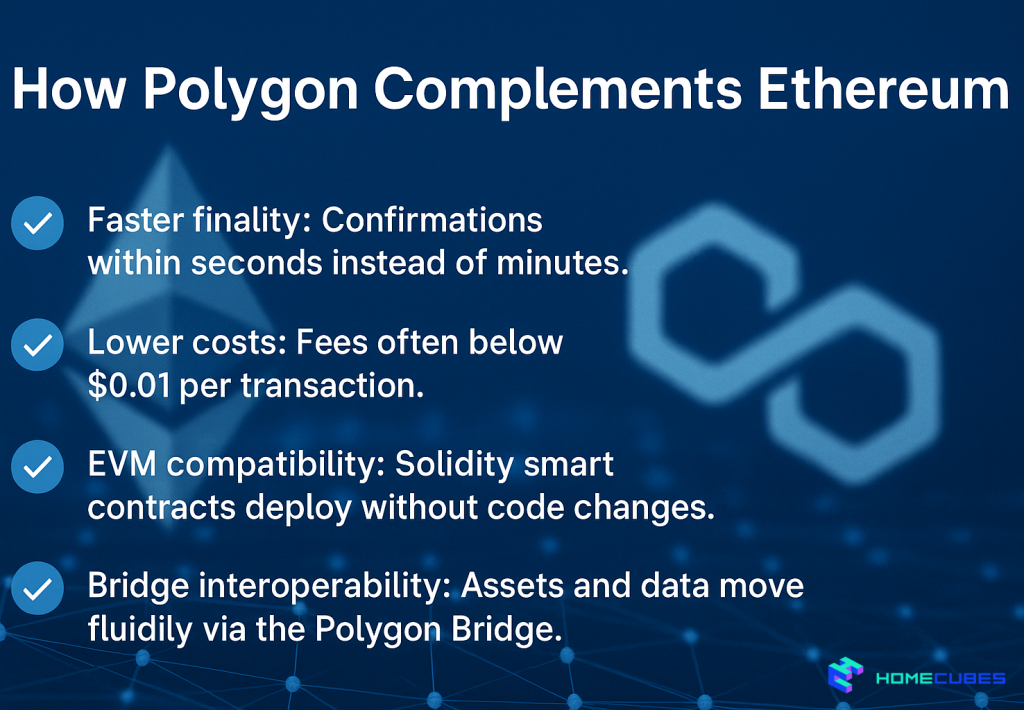
These practical advantages explain why developers and investors repeatedly cite scalability as one of the most important benefits of Polygon Matic.

Polygon’s micro-fee environment makes blockchain interactions truly accessible.
Where Ethereum users may pay several dollars in gas, Polygon averages less than a cent per transaction.
The 2025 Rio network upgrade — reported by The Block — further reduced gas prices and optimized block production, cementing Polygon’s leadership in affordable scalability.
For Web3 games, micro-payments, or NFT minting, this pricing consistency is transformative.
Polygon’s architecture supports up to 65,000 transactions per second (TPS), vastly outpacing Ethereum’s ~15 TPS.
This throughput allows near-instant user interactions — critical for DeFi protocols, on-chain trading, and enterprise dApps.
As more rollup and CDK chains join the network, aggregate throughput continues to rise, reinforcing Polygon’s position as a high-speed Layer-2 framework.
Security remains foundational. Polygon’s Proof-of-Stake consensus and Ethereum anchoring ensure integrity while keeping decentralization intact. Over 100 active validators secure the network.
With the POL token migration, staking will expand across multiple Polygon chains, creating a unified validator economy.
The Polygon Technology Blog outlines this “Gigagas Roadmap,” targeting 100,000 TPS without compromising decentralization.
Interoperability is central to Polygon’s design.
The network’s bridges connect Ethereum, BNB Chain, Avalanche, and other ecosystems, enabling seamless movement of tokens, NFTs, and data.
In 2025, Polygon introduced cross-rollup communication between its PoS and zkEVM chains, a major interoperability leap that allows liquidity and data to flow freely.
Such flexibility has made interoperability one of the most prized benefits of Polygon Matic among developers and enterprises alike.
Polygon mirrors Ethereum’s developer environment, offering full EVM compatibility. Existing Solidity smart contracts migrate easily, saving time and cost.
The Polygon CDK (Chain Development Kit) empowers organizations to launch custom Layer-2 chains inheriting Ethereum’s security while leveraging Polygon’s speed.
Developer engagement remains record-high: CoinLaw’s 2025 Polygon Statistics note over 460,000 new developer registrations this year alone, reflecting continuous innovation and support infrastructure unmatched by most competitors.
Polygon’s growth extends across finance, gaming, identity, and sustainability.
According to Messari, Polygon ranked fifth globally for tokenized real-world assets (RWAs) with over $271 million represented on-chain in Q1 2025.
From Nike’s .Swoosh NFT campaigns to government pilot programs and carbon-credit tokenization, Polygon demonstrates real utility across industries — reinforcing why scalability and cost-efficiency are defining benefits of Polygon Matic.
Challenge
Ethereum’s congestion drove borrowing and lending fees to unsustainable levels for smaller users.
Solution
Aave launched its DeFi protocol on Polygon’s PoS chain, immediately slashing gas fees from $20+ to mere cents and allowing micro-transactions and smaller deposits.
Results
This case shows how Polygon’s throughput and affordability directly enhance adoption and usability — benefits equally relevant to tokenized real-estate and on-chain property marketplaces.
Even strong ecosystems face risks. Recognizing them ensures safe participation.
Bridges remain high-value targets; always use audited official tools like the Polygon Bridge.
Validator concentration could affect governance; staking decentralization initiatives aim to mitigate this.
Uninformed swaps can lead to loss; verify contract addresses during migration.
Audit contracts before deployment; use reputable auditing firms.
Frameworks such as VARA 2025 Rulebooks and MiCA in Europe could alter compliance expectations. Projects should align early with evolving standards.
Proper risk management enables users to capture the benefits of Polygon Matic confidently.
Polygon consistently delivers the industry’s most predictable fees.
Because of its design, Polygon avoids the gas-spike volatility common on Ethereum.
Developers can estimate live costs through Polygon’s Gas Station API.
Polygon’s 2.0 Roadmap transitions it from a single PoS chain to a network of interoperable Layer-2 chains.
Upcoming priorities include:
With consistent innovation and regulatory awareness, the future benefits of Polygon Matic will extend beyond DeFi — shaping compliant, real-world Web3 economies.
What differentiates Polygon from other Ethereum scaling solutions?
Polygon uniquely combines PoS, zkEVM, and customizable CDK chains, offering flexibility unmatched by Optimism or Arbitrum.
How fast are transactions on Polygon?
Typically within 2–3 seconds — far quicker than Ethereum’s 15-plus seconds.
Is Polygon secure?
Yes. Validators stake MATIC (soon POL), and Polygon’s security is anchored to Ethereum’s base layer.
How can I bridge tokens to Polygon?
Use the official Polygon Bridge for ERC-20, ERC-721, and native assets.
Which industries use Polygon today?
DeFi, NFTs, gaming, identity, and tokenized real-estate sectors all rely on Polygon’s infrastructure.
What happens to MATIC after 2025?
It will gradually migrate to POL — Polygon’s universal staking and governance token.
The benefits of Polygon Matic extend beyond cheaper fees or faster blocks — they embody a scalable and inclusive Web3 vision.
By tackling Ethereum’s limitations, Polygon has become a foundational pillar of decentralized innovation — powering everything from gaming to tokenized property ownership.
For investors and developers in Dubai’s Web3 ecosystem, Polygon offers the reliability and efficiency needed to transform blockchain concepts into operational success.
At Homecubes, we recognize how Polygon’s scalability aligns with the future of fractional property ownership and tokenized real-estate.
Our platform leverages the benefits of Polygon Matic to deliver transparent, compliant investment solutions in line with Dubai’s blockchain vision.
⚠️ Regulatory Notice: Homecubes has applied for its VARA license for real-estate tokenization and virtual-asset services. Our platform will launch commercially upon approval.
Until then, we’re building investor-ready, regulation-aligned infrastructure for tomorrow’s property market.
👉 Learn more or contact us here

Table of Contents Introduction Global Demand Dubai Real Estate – Snapshot Why Dubai Stands Out…

Dubai’s real estate market has moved from a speculative frontier to a globally recognized hub…

Table of Contents Introduction Market Overview: H1 2025 by the Numbers Key Drivers Behind the…